
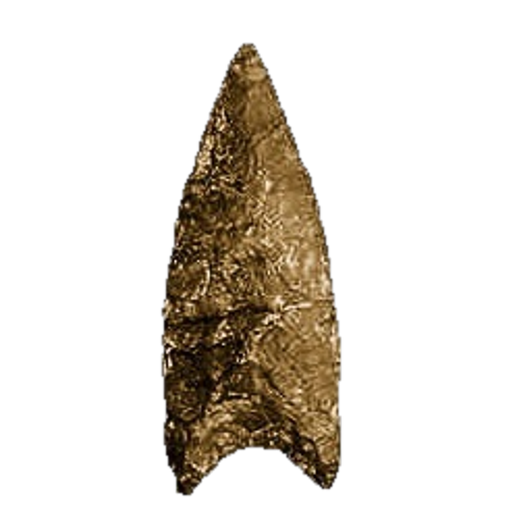
Arrowhead type
Annie Lake Point
Annie Lake5,100 - 4,400 B.P.Middle Archaic4 reference photos
Key facts
- Age
- 5,100 - 4,400 B.P.
- Cultural period
- Middle Archaic
- Size
- Medium
- Shape
- Lanceolate
- Glacial period
- Middle Holocene
More from the Archaic period
Description
This triangular point exhibits a slender profile, measuring between 2.25 and 4 inches in length, with a cross-sectional shape that is distinctly elliptical. The blade's curvature is characterized by an excurvate shape, where the edges converge at the apex, then expand to reach maximum width approximately midway along the point's length, before subtly recurving inward as it approaches the base. The basal margin is marked by a pronounced concavity, accentuated by sharp, well-defined corners. The flaking pattern observed on this point is random, lacking a discernible order or orientation.
Size
The dimensions of the arrowheads are characterized by the following measurements: overall length ranges from 29 to 82 mm, while the width of the blade spans from 17 to 36 mm. Additionally, the basal concavity is measured to be between 3 to 6 mm.
Distribution
These artifacts are mainly discovered in the southwestern region of Yukon. Sightings have been documented in Seela Pass and Dawson City, located in western central Yukon. They can also be located in the northwestern parts of British Columbia and southeastern areas of Alaska. The complete range remains unclear
Additional information
In the realm of Native American archaeology, the Annie Lake points exhibit a notable similarity to the more recent Whitehorse Lake points, with a key distinction lying in the depth of their basal concavity. Specifically, Annie Lake points are characterized by a deeply concave base and sharper basal corners, whereas Whitehorse Lake points display a less pronounced concavity and more rounded basal corners, as observed by Greer in 1993. This subtle yet significant difference highlights the importance of meticulous analysis in distinguishing between these point styles.
The stratified context in which Annie Lake points are found provides valuable insights into the cultural dynamics of the region. At Annie Lake, these points are situated between layers containing Northern Archaic Tradition side-notched points, specifically those associated with the Little Arm Phase in the lower layer and the Taye Lake Phase in the upper layer. The presence of Annie Lake points in this "inserted" deposition suggests a potential incursion by an external culture, possibly originating from the Northern Plains. This theory proposes that the Annie Lake point-bearing culture may have temporarily displaced the existing population, only to be subsequently replaced by the Taye Lake Phase. This complex sequence of events underscores the dynamic nature of cultural interactions and migrations in the region.
The discovery of Annie Lake points in this distinct stratified context offers a unique window into the archaeological record, allowing researchers to reconstruct the intricate history of cultural exchange and replacement in the area. By examining the characteristics of these points and their position within the stratigraphic sequence, archaeologists can gain a deeper understanding of the complex social and cultural processes that shaped the lives of Native American communities in the region. The Annie Lake points, with their distinctive basal concavity and sharp corners, serve as a tangible link to the past, providing a fascinating glimpse into the lives of the people who crafted and used them.
Identified by
- Named by
- Sheila C. Greer
- Year
- 1993
- Type site
- Annie Lake Site (JcUr-3) Yukon territory, Canada
Similar types
Types that are easy to confuse with the Annie Lake point.
- Basally Thinned Triangular
- Dorset
- Minto
- Sub Triangular
- Whitehorse