
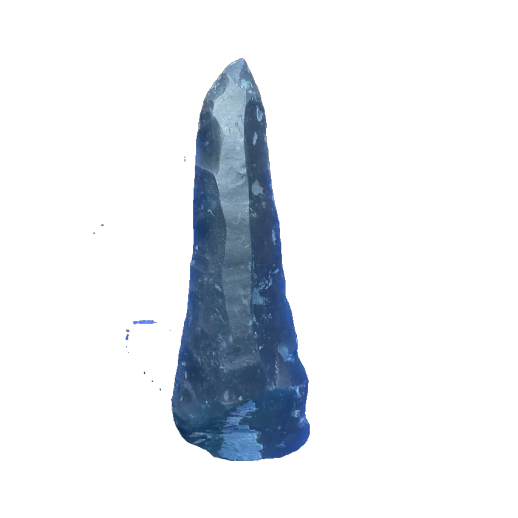
Arrowhead type
Anagula Blades and Cores Point
Anagula Blades and Cores9,200 - 8,000 B.P.7 reference photos
Key facts
- Age
- 9,200 - 8,000 B.P.
- Culture
- Aleutian Tradition
- Size
- Small to Medium
- Shape
- Ovoid
Description
The artifact exhibits a broad range of sizes, from compact to substantial, with an irregular morphology characteristic of a blade. Its formation is attributed to the removal of a flake from a core, resulting in a distinctive, varied shape.
Size
Small to Medium
Distribution
This artifact occurs on Anagula Island within the Aleutian Islands of Alaska.
Mainly found in
Additional information
The Anangula blades, a type of lanceolate blade, were first identified by Sarah B. and William S. Laughlin, as well as Mary E. McDowell, based on discoveries made on Anangula Island in Alaska. This island, situated within the former boundaries of the Bering Land Bridge, has yielded a unique archaeological site characterized by an intense occupation. Notably, the site's technological configuration is distinct in that it appears to have been dedicated solely to the production of blades and burins, with no evidence of other tool types. This specialized focus suggests that the Anangula toolkit was designed to prioritize energy efficiency during manufacture, resulting in implements that were likely intended to be disposable.
The Anangula blades themselves are large, measuring between 3 and 5 inches in length, and are dated to the early Holocene period, approximately 8,550 years before present. They were created by removing blades from cores, with minimal additional modification beyond the occasional incorporation of a burin. The presence of transverse burins on these blades is a characteristic also found in Japanese and Asian archaeological contexts, as noted by Gibbons and Ames in 1998. The Anangula site has been the subject of several studies, including those by Laughlin in 1938 and Aigner in 1970, which have shed light on the site's unique characteristics and the cultural practices of its former occupants. More recent research, such as that conducted by McCartney and Veltre in 1999, has further expanded our understanding of the prehistory of the Aleutian Islands and the ways in which the region's inhabitants adapted to their insular environment.
The discovery of the Anangula blades and the study of the Anangula site have significant implications for our understanding of the technological and cultural developments of the region's early inhabitants. The site's unique characteristics, including its specialized toolkit and emphasis on energy efficiency, provide valuable insights into the adaptive strategies employed by these early populations. Furthermore, the presence of transverse burins on the Anangula blades highlights the potential for cultural exchange and technological diffusion between the Aleutian Islands and other regions, including Japan and Asia. As such, the Anangula blades remain an important area of study in the field of archaeology, offering a fascinating glimpse into the lives and cultural practices of the region's earliest inhabitants.
Identified by
- Named by
- Sarah B. and William S. Laughlin and Mary E. McDowell
- Year
- 1975
- Type site
- Anagula Blade Site, Anagula Island, Alaska