
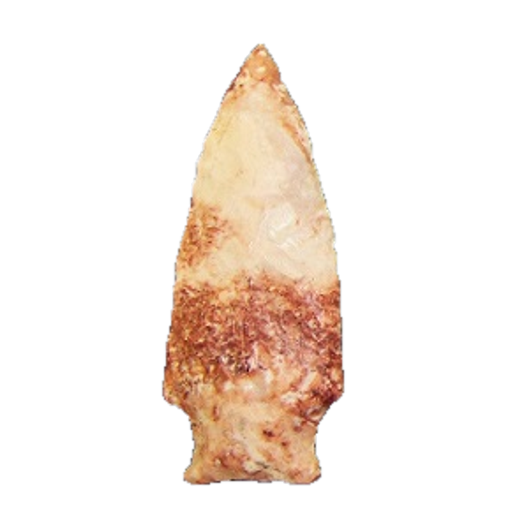
Arrowhead type
Allendale Point
Allendale4,000 - 3,000 B.P.Late Archaic to Early Woodland4 reference photos
Key facts
- Age
- 4,000 - 3,000 B.P.
- Cultural period
- Late Archaic to Early Woodland
- Size
- Medium
- Shape
- Expanding Stem
- Material
- Chert
- Glacial period
- Neoglacial
Description
This triangular to lanceolate projectile point exhibits a sturdy profile, measuring between 1.75 and 3 inches in thickness, with an elliptical cross-sectional shape. The blade's curvature is subtly excurvate, occasionally giving way to a straighter configuration. The shoulders display a range of expression, from pronounced to subdued, and may be oriented horizontally or slope upward at a slight angle. The stem is characteristically short, with a morphology that can be either straight or slightly expanding. The base of the point is marked by a gentle convexity, often accompanied by sharp, well-defined basal corners, although it is not uncommon for one of these corners to be damaged, likely due to functional use, as observed by Whatley (2003). The flaking pattern on this point is random, lacking a deliberate or organized arrangement.
Size
The dimensions of the arrowheads are characterized by the following measurements: overall length ranges from 33 to 51 mm, with a mean length of 39 to 42 mm. The stem measures between 6 and 9 mm in length, averaging 7 mm. The blade width varies from 18 to 31 mm, with an average width of 20 to 23 mm. The neck width is between 12 and 17 mm, averaging 14 to 15 mm. The stem width ranges from 13 to 18 mm, with an average of 14 to 16 mm. The thickness of the arrowheads is between 6 and 10 mm, as reported by Whatley (2002).
Distribution
This type is mainly located in the middle to southern regions of the Savannah River Valley in South Carolina and Georgia. It is typically discovered in locations linked to Ancestral Puebloan settlements. It can also be discovered on the Colorado Plateau, spanning from the southern Manti La Sal mountains and extending south to the Su Site in New Mexico, and reaching west to Navajo Mountain
Mainly found in
Also found, less often, in
Additional information
In the realm of Native American archaeology, the Allendale projectile point is a notable example of a regional variant, confined to a limited geographic area within the Piedmont region of the southeastern United States. This specific type of arrowhead was first identified by amateur archaeologist David Topper, who discovered numerous specimens at the Allendale quarry site, also known as the Topper Site, and other locations within Allendale County, South Carolina. Characterized by their medium size, typically measuring between 2 ½ to 3 inches in length, these points feature expanding blades, prominent shoulders that can be either straight or rounded, and short stems with bases that range from straight to convex.
The distribution of Allendale points is largely restricted to the southeastern United States, with confirmed finds in South Carolina, Georgia, and northern Florida. Their usage is associated with the late Archaic period, a time of significant cultural and technological development among Native American communities. Notably, many of these points were crafted from Allendale Quarry chert, a high-quality material sourced from quarries in Allendale County, South Carolina. This preference for local materials highlights the resourcefulness and adaptability of the region's indigenous populations.
The Allendale point has been referenced in various archaeological studies, including the work of K.E. Sassaman, who employed the designation "MALA points" in his survey of Savannah River sites in South Carolina. Further research, such as the study by Lewis-East (2002), has shed light on the Early and Late Archaic occupations along the Savannah River in Aiken County, South Carolina, providing valuable context for the Allendale point within the broader cultural and chronological framework of the region. These findings, in conjunction with the work of Sassaman and other researchers, contribute to a deeper understanding of the technological, social, and cultural dynamics of Native American communities in the southeastern United States during the late Archaic period.
Identified by
- Named by
- David Topper
- Year
- 1976
- Type site
- Allendale Quarry Site, Allendale County, South Carolina
Similar types
Types that are easy to confuse with the Allendale point.
- MALA
- Savannah River