
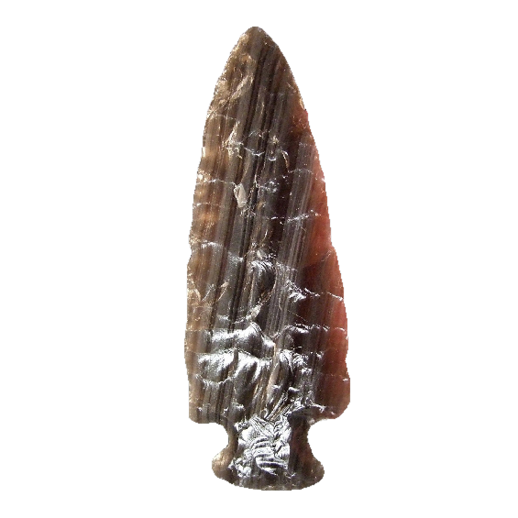
Arrowhead type
Alamo Point
AlamoAlamo Cluster2,500 - 1,500 B.P.Late Archaic2 reference photos
Key facts
- Age
- 2,500 - 1,500 B.P.
- Cultural period
- Late Archaic
- Size
- Medium to Large
- Shape
- Expanding Stem
- Material
- Obsidian
- Glacial period
- Roman Warm
More from the Archaic period
Description
This triangular point exhibits a distinctive morphology, characterized by a slender profile and expansive dimensions, often falling within the large to extra-large size range. Its cross-sectional geometry is marked by a flattened shape, while the blade itself displays an excurvate curvature. Notably, many specimens feature elongated blades with edges that converge in a nearly parallel fashion as they approach the shoulders, which can exhibit a range of configurations, from subtly barbed to horizontally oriented. The stem, which may be slightly expanding or straight, is typically accompanied by a convexly shaped base. The overall craftsmanship of these points is often of high quality, with flaking patterns that appear random and lacking a discernible order, suggesting a deliberate and skilled manufacturing technique.
Size
The arrowheads exhibit a range of dimensions, with overall lengths spanning 94 to 210 mm. The stem section measures between 14 and 21 mm in length. In terms of width, the blade ranges from 44 to 51 mm, while the neck width varies from 17 to 21 mm. The stem itself is between 22 and 33 mm wide. The thickness of the arrowheads falls within a range of 8 to 11 mm.
Distribution
This type is mainly discovered in the San Francisco Bay vicinity and extending into the Sacramento Delta territory.
Mainly found in
Additional information
In the realm of California archaeology, a notable discovery stands out - the largest spear-type point unearthed in the state. This distinctive artifact is believed to hold ceremonial significance, as evidenced by its frequent presence in funerary contexts. A striking aspect of this point type is the absence of utilitarian variants, suggesting its primary function was ritualistic rather than practical. The uniqueness of this point's design is noteworthy, as no other known types replicate its fundamental concept. However, it is intriguing to observe that the technological principles underlying its manufacture bear similarities to those employed in the production of Middle Woodland points, such as the Ross, Snyders, and Norton points, which are characteristic of the Midwestern region. As noted by Justice in 2002, this technological overlap highlights the shared knowledge and craftsmanship that existed among ancient cultures, despite geographical distances.
Identified by
- Named by
- Noel Justice
- Year
- 2002
- Type site
- Alamo Site (CA Cco 331), Contra Costa County, California
Similar types
Types that are easy to confuse with the Alamo point.
- Rossi
- Sierra Stemmed