
Stone tool type
Adze
Adze9,000 - 500 B.P.Used by Archaic hunter-gatherers, Woodland cultures, Mississippian agriculturalists, and numerous Pacific Northwest coastal groups.4 reference photos
Key facts
- Age
- 9,000 - 500 B.P.
- Cultural period
- Used by Archaic hunter-gatherers, Woodland cultures, Mississippian agriculturalists, and numerous Pacific Northwest coastal groups.
- Size
- Small to Medium
- Shape
- Socketed or lashed wedge-shaped ground-stone cutting tool with perpendicular (adze-style) orientation.
- Glacial period
- Late Holocene
More from the Archaic, Woodland, Mississippian periods
Description
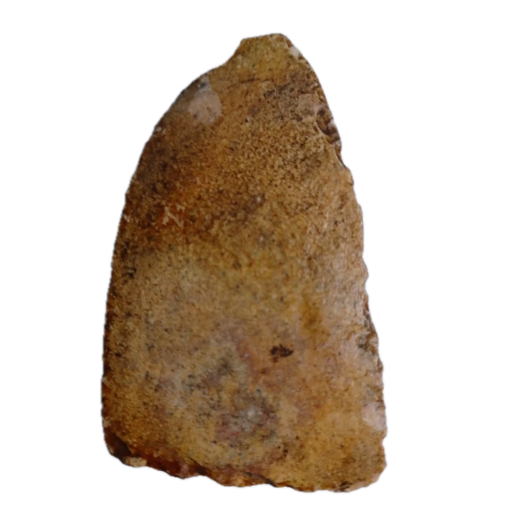
An adze is a ground-stone woodworking tool similar to an axe, but oriented differently. While an axe has its bit aligned with the handle for chopping downwards, an adze has its cutting edge positioned perpendicular to the handle. This allows for planing, scraping, smoothing, and hollowing wood. Stone adzes are typically wedge-shaped, with a beveled cutting bit and a poll end designed to fit into a socketed or lashed handle. Materials include basalt, greenstone, diorite, slate, and other fine-grained stones suitable for grinding and polishing.
Size
Most stone adzes measure 8 to 20 cm (3 to 8 inches) in length. Width typically ranges from 3 to 7 cm (1.25 to 3 inches). Thickness usually falls between 1.5 and 4 cm (0.5 to 1.5 inches). Adzes have a tapered body that thickens toward the poll and narrows toward the bit. The bit is ground and polished into a forward-beveled cutting edge. Cross-sections vary from oval to rectangular to slightly triangular. Some adzes were designed for heavy cutting; others for fine smoothing work. Many adzes show striations, polish, and step-fractures from repeated wood planing.
Distribution
Stone adzes are found widely across North America, with the greatest concentrations in the Eastern Woodlands, Pacific Northwest, Great Lakes, and parts of the Midwest. They occur frequently in areas with heavy woodworking traditions, including river valleys with canoe usage, forested regions requiring timber shaping, and settled agricultural communities. Adzes are also found throughout the Plains, though less commonly, and appear in early Archaic to late prehistoric sites. In the Pacific Northwest, adzes were essential for woodworking in plank house construction and canoe building.
Additional information
The stone adze is one of the most important woodworking tools in prehistoric North America. Its perpendicular edge allowed people to hollow logs, carve bowls, smooth timbers, shape mortises, and produce dugout canoes. In the Pacific Northwest, specialized adzes were used for plank house construction and cedar carving. Adzes were either inserted into a bent-wood socket or lashed to a short handle. Many adzes were resharpened repeatedly, shortening the tool over time. High-quality polished adzes also appear in ceremonial contexts, particularly among coastal and wood-working societies.