
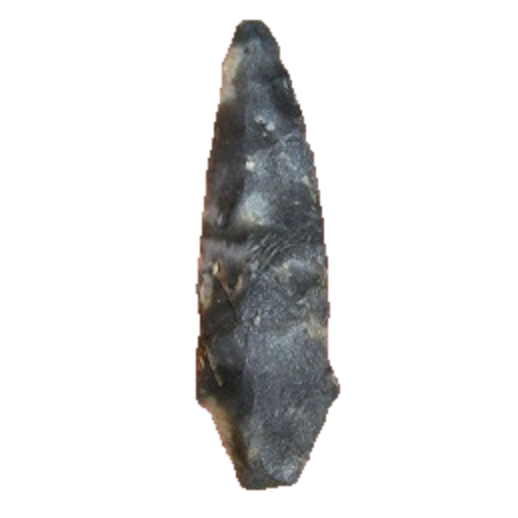
Arrowhead type
Accokeek Creek Point
Accokeek Creek2,600 - 1,700 B.P.Early Woodland2 reference photos
Key facts
- Age
- 2,600 - 1,700 B.P.
- Cultural period
- Early Woodland
- Size
- Small
- Shape
- Contracting Stem
- Material
- Utilized
- Glacial period
- Roman Warm
More from the Woodland period
Description
This diminutive point, measuring between 1 to 1.5 inches in length, exhibits a stout profile with an elliptical cross-sectional shape. The blade edge can range from gently excurvate to straight, displaying variability in its curvature. The shoulders are either faintly defined or absent, characterized by a subtle, rounded contour that slopes upward, imparting a diamond-like silhouette to the point. A distinctive feature is the contracting stem, which tapers to a rounded base. The overall craftsmanship of this point is relatively coarse, with a flaking pattern that appears random and unstructured, suggesting a more expedient manufacturing technique.
Size
The arrowheads exhibit dimensions ranging from 25 to 50 mm in overall length, with widths spanning 9 to 16 mm, and thicknesses varying between 6 and 10 mm.
Distribution
This type is mainly discovered in the southeastern parts of New England and extending to Virginia. Typically located near the eastern seaboard areas.
Also found, less often, in
Additional information
The Accokeek Creek point type, named after the Algonquian word for "at the edge of the hill," owes its designation to the renowned artist and avocational archaeologist Alice Ferguson. Ferguson's connection to the site, known as Moyaone, was personal, as it was located on her land in Prince George County, Maryland, near the town of Accokeek. The site, a palisade village situated on the banks of Accokeek Creek, a 14-mile tidal tributary of Potomac Creek and ultimately the Potomac River, was the subject of initial excavations by Ferguson before professional archaeologists were invited to contribute to the research.
Characterized by their small size, typically ranging from 1 to 1.5 inches in length, Accokeek Creek points are often crudely made and exhibit a distinctive diamond-shaped outline, which can be asymmetrical. These projectiles, variants of the Rossville point type, feature expanded blades that narrow to waists with weak shoulders, accompanied by medium-length contracted stems and rounded bases. The distribution of Accokeek Creek points encompasses the New England states, with their usage spanning the Early Woodland to Late Archaic period. This chronological context is supported by the comprehensive research presented in "The Accokeek Creek Site, A Middle Atlantic Seaboard Culture Sequence," a seminal work authored by Robert L. Stephenson, Alice L. Ferguson, and Henry G. Ferguson, published in 1963 as part of the Anthropological Papers series by the University of Michigan's Museum of Anthropology.
Notable for their unique combination of characteristics, Accokeek Creek points offer valuable insights into the technological and cultural practices of the indigenous populations that inhabited the region. The fact that these points are often found in association with other artifact types from the same period highlights the significance of the Accokeek Creek site as a cultural sequence, providing a window into the lives of the people who lived along the Potomac River and its tributaries. As such, the study of Accokeek Creek points contributes to a deeper understanding of the complex cultural dynamics and technological developments that defined the Early Woodland to Late Archaic period in the region.
Identified by
- Named by
- Alice Ferguson
- Year
- 1963
- Type site
- Accokeek Creek (18PR8) (aka: Moyaone), Prince George County, Maryland
Similar types
Types that are easy to confuse with the Accokeek Creek point.
- Taconic